
Introduction
Artificial Intelligence (AI) is reshaping the financial landscape at an unprecedented pace. What once required hours of manual analysis can now be accomplished in minutes, enabling finance teams to process larger volumes of information, identify trends faster, and support decision-making with greater efficiency.
For senior management, however, the true value of AI does not lie in replacing financial professionals. Instead, AI should be viewed as a strategic enabler that enhances human capabilities while leaving critical judgment, leadership, and decision-making in the hands of experienced professionals.
As organizations continue investing in AI-driven solutions, the key question is no longer whether to adopt AI, but how to integrate it effectively into executive decision-making processes.
AI as a Force Multiplier for Financial Analysis
One of AI’s greatest strengths is its ability to rapidly process vast amounts of structured and unstructured financial data.
Advanced AI solutions can automate data extraction, perform complex calculations, identify anomalies, and generate insights that would otherwise require extensive manual effort. Tasks that traditionally consumed hours can now be completed in a fraction of the time.
This transformation allows finance professionals to redirect their attention from data gathering to higher-value activities such as strategic planning, capital allocation, performance management, risk assessment, and business growth initiatives.
Rather than spending valuable time collecting information, finance leaders can focus on interpreting results and driving strategic action.
Delegating the Heavy Lifting to AI
AI excels at automating many of the analytical activities that traditionally consume significant time and resources, including:
- Financial statement analysis
- Liquidity, profitability, and solvency calculations
- Cash flow forecasting
- Variance analysis
- Trend identification
- Data reconciliation
- Fraud detection
- Risk monitoring
By automating these repetitive and data-intensive tasks, organizations can improve efficiency, enhance accuracy, and accelerate decision-making.
The objective is not to replace finance professionals but to empower them to operate at a higher strategic level.
The Importance of Traceability and Verification
Despite its impressive capabilities, AI is not infallible.
Generative AI models can occasionally misinterpret business context, overlook critical assumptions, or generate inaccurate conclusions when working with incomplete or ambiguous information.
For this reason, organizations must establish robust governance frameworks that prioritize transparency, traceability, and accountability.
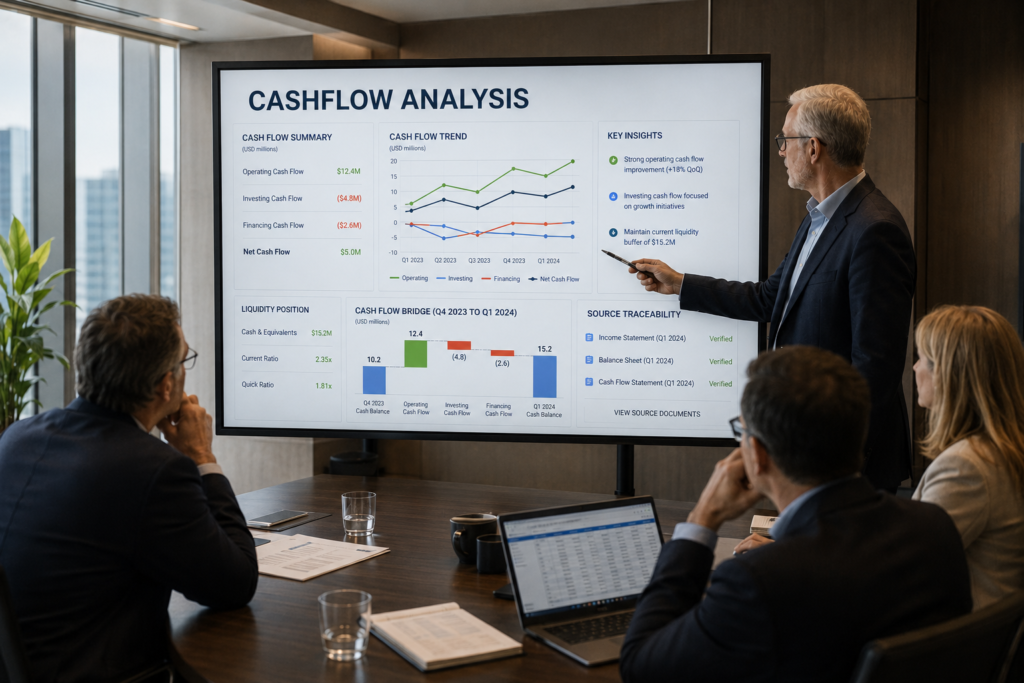
Finance leaders should insist on AI solutions that allow every calculation, forecast, and recommendation to be traced back to its original source. Decision-makers must be able to validate outputs quickly and confidently before acting on them.
Trust in AI should never replace verification.
The most effective AI implementations are those that combine speed with transparency and control.
Why Human Judgment Remains Essential
While AI can identify patterns and forecast potential outcomes, it cannot fully understand the complexities of organizational dynamics, stakeholder relationships, market sentiment, or strategic priorities.
Financial decisions rarely depend solely on numerical analysis.
A cash flow forecast may indicate the need to reduce expenses, but only experienced executives can determine whether those reductions could negatively impact customer service, operational performance, innovation, employee engagement, or long-term growth.
Likewise, AI can detect trends and emerging risks, but it cannot assess corporate culture, leadership considerations, competitive positioning, or broader strategic implications.
These decisions require experience, judgment, and business insight.
Simply put, AI provides information. Leadership provides direction.
The Future of Financial Leadership
The future of financial management is not a choice between technology and people.
The organizations that achieve sustainable success will be those that effectively combine the speed and analytical power of AI with the experience, judgment, and strategic thinking of seasoned leaders.
Finance professionals who embrace AI as a decision-support tool will be better positioned to improve organizational agility, enhance forecasting capabilities, and deliver meaningful business value.
Tomorrow’s finance leaders will not merely manage financial information. They will orchestrate the collaboration between advanced technology, business intelligence, and human expertise.
Competitive Advantage in the Next Decade
As AI adoption accelerates, the competitive landscape will increasingly favor organizations that can transform data into actionable intelligence.
Companies that successfully integrate AI-driven analytics with strong leadership and operational expertise will be better equipped to:
- Respond quickly to market changes
- Improve capital allocation decisions
- Optimize working capital management
- Identify emerging risks earlier
- Enhance forecasting accuracy
- Strengthen strategic planning capabilities
The competitive advantage of the next decade will belong to organizations that successfully combine AI-driven insights, business intelligence, and experienced leadership.
Conclusion
Artificial Intelligence is rapidly becoming one of the most powerful accelerators in modern financial analysis. It enables organizations to process information faster, improve efficiency, and uncover insights that might otherwise remain hidden.
However, speed alone does not create value.
The organizations that thrive in the years ahead will be those that successfully balance AI-driven automation with human judgment, strategic thinking, and leadership experience.
The future belongs not to AI alone, nor to human expertise alone, but to the intelligent integration of both.
As we increasingly integrate these powerful technologies into our executive workflows, we must ask ourselves:
Are we taking the right direction in balancing the speed of AI-driven automation with the insight, judgment, and strategic oversight that only experienced leaders can provide?
About the Author
Eduardo J. Olmos, MBA is a finance executive with more than four decades of experience in corporate finance, operations, strategic planning, business intelligence, and organizational transformation. His professional background includes executive leadership roles in manufacturing and multinational environments, helping organizations leverage data, technology, and financial expertise to improve performance and drive long-term value creation.
Understanding cash flow today can help prevent challenges tomorrow, let’s talk
Eduardo J. Olmos, MBA | NMLS #2439259