
The American housing market has spent the last several years in a state of high-altitude suspension. We call it the “deep freeze,” but that description is incomplete. It is not that the desire for homeownership has cooled; it is that the “purchasing math” simply stopped working for the average family. Currently, millions of potential buyers sit in a perpetual waiting room, sidelined by a combination of sticker-shock prices and the stubborn hope for a return to the 5% mortgage rate.
However, as a strategist looking at the cold data of 2026, the central thesis is clear: waiting for a rate drop that may never arrive is often the most expensive financial decision a household can make. The “cost of waiting” is no longer a theoretical concept—it is a measurable erosion of long-term wealth.
1. The “New Normal” is Already Here
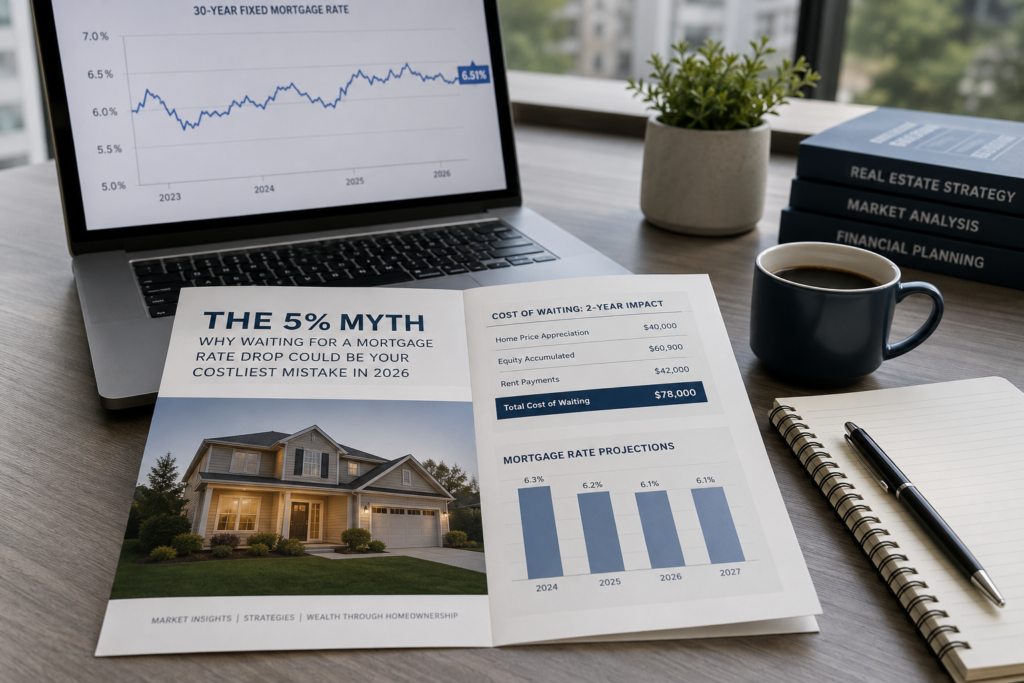
The expectation that mortgage rates will retreat to pandemic-era levels is a fantasy that ignores structural economic shifts. We are currently observing a market that has plateaued rather than paused. Projections from the nation’s leading financial entities suggest a remarkably consistent horizon through the end of 2027:
- Fannie Mae: Forecasts a 30-year fixed rate of 6.2% by Q4 2027.
- Wells Fargo: Forecasts a 30-year fixed rate of 6.2% by Q4 2027.
- Mortgage Bankers Association (MBA): Forecasts a 30-year fixed rate of 6.5% by Q4 2027.
Buyers often wonder why the Federal Reserve’s signals for rate cuts haven’t triggered a plunge in mortgage costs. The answer lies in “Mortgage Spreads”—the gap between the 10-year Treasury yield and mortgage rates. Historically, this spread sits between 1.6% and 1.8%. Currently, it remains elevated at 2.01%, keeping rates in the mid-6% range even when yields soften. Furthermore, the “Lock-in Effect”—where homeowners cling to legacy mortgages of 2.5% to 3.5%—continues to choke supply, ensuring that rates remain the primary lever for market movement.
As Sam Khater, Chief Economist at Freddie Mac, recently noted:
“Rates have remained relatively stable during the last six weeks. Meanwhile, purchase activity has softened modestly and refinance activity has continued to climb recently, reflecting the responsiveness of borrowers to current rate levels.”
2. The Invisible $78,000 Bill for Waiting
Market timing is a gambler’s game, but the erosion of purchasing power is a mathematical certainty. Consider the “Cost of Waiting” analysis using representative data from the Utah market. If you delay the purchase of a $500,000 home for just two years, you aren’t just missing a payment; you are incurring a massive “invisible bill”:
- Appreciation Costs: At a modest 3% annual appreciation, that 500,000 home will cost **530,450** in two years—a $30,450 premium.
- Lost Capital from Rent: At 2,000 per month, you will forfeit **48,000** over two years with zero return on investment.
The most damning figure, however, is the Equity Gap. A buyer who acts today will have accumulated approximately $60,900 in appreciation equity alone after two years, plus the benefit of principal paydown. The “waiter” starts at zero two years from now, having lost nearly $80,000 in realized and potential wealth.
3. Why Lower Rates Might Actually Make Homes More Expensive
There is a dangerous paradox in waiting for a 0.5% rate drop. According to J.P. Morgan’s analysis, such a decrease acts as a “thawing” mechanism, triggering a massive influx of sidelined buyers who immediately compete for the same limited inventory.
This is best understood through the Thawing Index, which weighs market health using a formula of 0.50 sales activity, 0.25 inventory levels, and 0.25 price stability. In high-elasticity markets like the Sun Belt (Texas and Florida), a surge in supply has allowed for a healthier thaw. However, in supply-constrained regions like the Northeast, any drop in rates is instantly “canceled out” by price hikes driven by bidding wars. In these “frozen” markets, the cost of waiting is exponentially higher because demand far outstrips the ability to build new units.
4. The “Cheat Code” of New Construction
While the resale market remains entangled in high spreads and the “lock-in” effect, the 2026 market offers a strategic loophole: new construction. Forward-thinking builders are using Forward Commitments through their affiliated lenders to bypass market volatility.
- Strategic Rate Buydowns: While resale rates hover at 6.5%, many builders are offering 3.99% fixed-rate 30-year mortgages.
- Monthly Savings: This “cheat code” can save a buyer upwards of $500 per month—a level of affordability that no amount of market timing on a resale home could replicate.
- Secondary Hedges: These homes emphasize “Energy Sovereignty” (pre-installed solar and battery systems) and modern efficiency, acting as a permanent shield against utility inflation and maintenance surprises.
5. Buying the House, Not the Rate (The Refi Strategy)
In an era where annual wage growth (3.4%) is barely keeping pace with home appreciation (3-4%), the “Buy Now, Refinance Later” strategy has evolved from a sales pitch into a necessary risk-mitigation tactic. By securing today’s price, you freeze your largest cost basis.
Securing a 30-year fixed rate provides immediate predictability. If the market experiences a significant shift in 18 months, you can capture the lower rate through a refinance. If it doesn’t, you have still protected yourself against the “Invisible Bill” of appreciation. Real estate veteran Dana Johns-Szucs captures the prevailing sentiment of the decade:
“The version I hear most often is: ‘I wish I had bought two years ago’ (ojala hubiera comprado hace dos años). I have never heard a buyer say they wished they had waited longer.”
6. The Psychology of the 2026 Buyer: From Status to Sovereignty
The 2026 buyer is no longer motivated by social status; they are motivated by wellness and sovereignty. Features once considered luxuries—such as “Acoustic Isolation” for remote work and solar-plus-storage systems—are now treated as financial hedges.
However, the sheer volume of data available today has led to “Paralysis by Analysis.” Many buyers are suffering from an “Aversion to Loss” bias, where the fear of making a “bad” investment prevents them from making a necessary one. This requires a shift toward transactional psychology: recognizing that a home is a shelter for capital as much as it is a shelter for a family. In a volatile economy, the “pain” of a missed opportunity is historically much more severe than the risk of buying into a stable, appreciating asset.
7. When Waiting is Actually the Right Move
As a strategist, I must clarify that waiting for market conditions is a gamble, but waiting for personal financial readiness is a strategy. There are three valid criteria for staying on the sidelines:
- Credit Score Thresholds: If a six-month effort can move you into a higher credit tier, the interest savings will be tangible.
- Reserve Deficits: If buying would exhaust your emergency fund, you are not ready for the “wellness” a home provides.
- Income Instability: Homeownership requires a predictable cash flow to manage fixed costs.
Crucially, geography should dictate your urgency. If you are in a supply-constrained market like the Northeast, your “Valid Waiting Criteria” must be much more stringent because the cost of delay is significantly higher than in the Sun Belt.
The Forward-Looking Summary: The Price of Hesitation
The 2026 housing market is not a market for the hesitant; it is a market of strategic opportunities. Between “Jobs Friday” volatility and global energy conflicts, the window for predictable pricing is narrow. Those waiting for 5% are chasing a ghost, while the “Invisible Bill” of rent and appreciation continues to accrue.
We must move past the era of information and into the era of execution. As you look at the current landscape, ask yourself: In five years, will you look back at today’s prices as the “expensive” peak, or the missed opportunity of a lifetime?
Eduardo J. Olmos
Mortgage Loan Originator
NMLS #2439259
This announcement is provided for informational and educational purposes only and does not constitute an offer to lend, a commitment to lend, or financial, legal, or tax advice. Loan approval is subject to underwriting and program guidelines.