
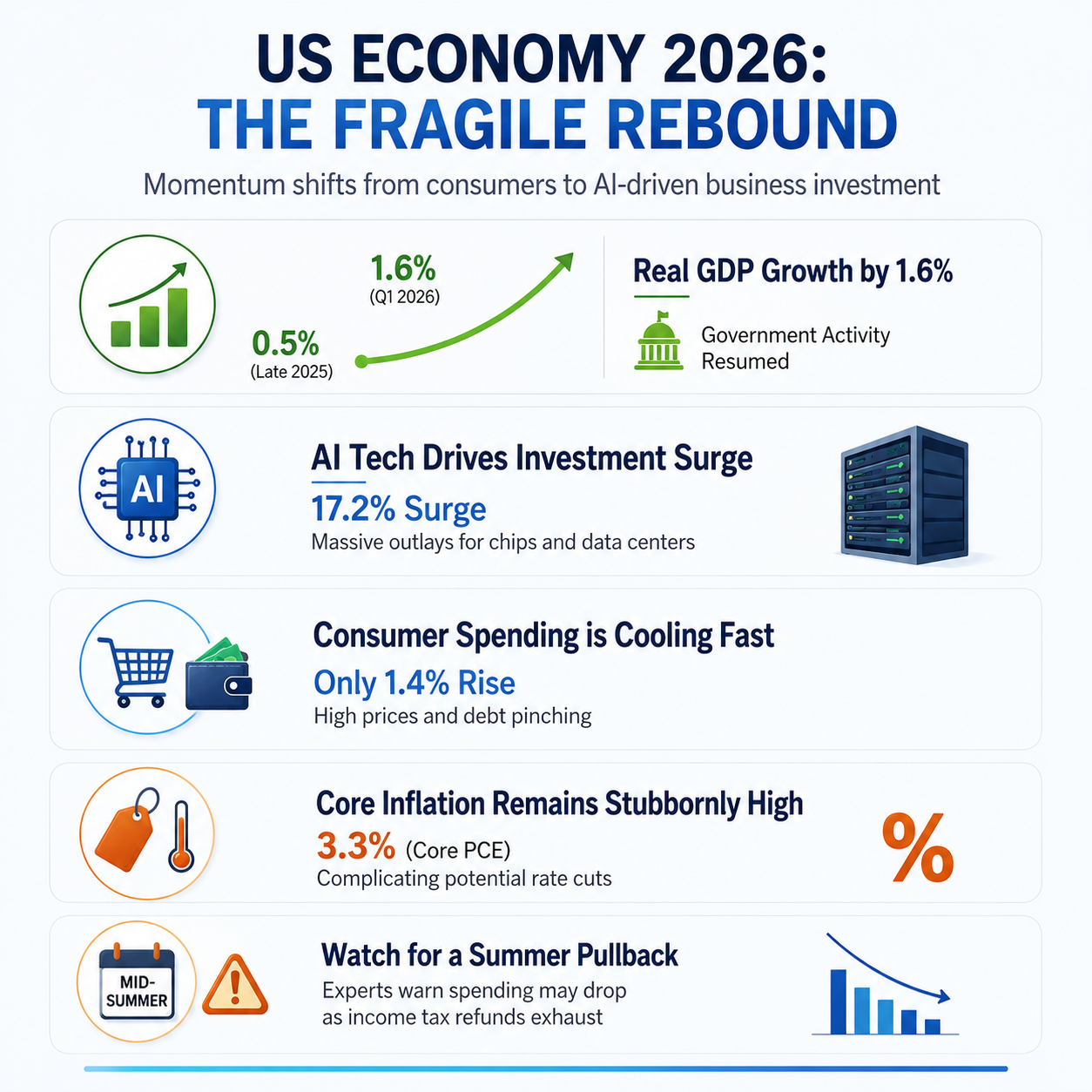
Momentum Shifts from Consumers to AI-Driven Investment
The U.S. economy entered 2026 with stronger-than-expected momentum, but the recovery remains uneven. While economic growth has accelerated and businesses continue investing heavily in artificial intelligence and technology infrastructure, consumers are showing signs of fatigue as inflation and higher borrowing costs continue to pressure household budgets.
The result is an economy that appears resilient on the surface yet remains vulnerable to inflationary pressures and slower consumer demand.
Economic Growth Rebounds
After ending 2025 with sluggish growth, the U.S. economy accelerated during the first quarter of 2026.
Real Gross Domestic Product (GDP) expanded by approximately 1.6%, a significant improvement compared to the 0.5% growth rate recorded in late 2025.
Several factors contributed to this rebound:
- Increased government spending
- Defense-related investments
- Infrastructure projects
- Strong corporate capital expenditures
While the growth rate is not exceptionally high by historical standards, it demonstrates that the economy continues to avoid recession despite elevated interest rates.
Artificial Intelligence Becomes a Major Growth Driver
One of the most significant economic trends in 2026 is the surge in business investment related to artificial intelligence.
Corporate spending on:
- Data centers
- Semiconductor manufacturing
- Cloud infrastructure
- AI software development
- Automation technologies
has increased dramatically.
Business investment in AI-related projects rose by approximately 17.2%, making it one of the strongest contributors to economic growth.
Many organizations view AI not simply as a technology trend but as a strategic necessity to improve productivity, reduce costs, and maintain competitiveness.
This wave of investment is creating opportunities across multiple industries, including technology, finance, healthcare, logistics, and real estate.
Consumer Spending Begins to Slow
While businesses continue investing aggressively, consumers are becoming more cautious.
Consumer spending growth has slowed to approximately 1.4%, reflecting pressure from:
- Persistent inflation
- Higher credit card balances
- Elevated mortgage rates
- Increased borrowing costs
- Reduced savings accumulated during prior years
Historically, consumer spending accounts for roughly two-thirds of U.S. economic activity. Any meaningful slowdown can have significant consequences for overall economic growth.
This creates a potential divergence between corporate strength and household financial stress.
Inflation Remains the Biggest Challenge
Perhaps the most important economic issue facing policymakers in 2026 is inflation.
Core Personal Consumption Expenditures (Core PCE), the Federal Reserve’s preferred inflation measure, remains elevated at approximately 3.3%.
Although inflation has declined significantly from the highs experienced in previous years, it remains above the Federal Reserve’s long-term target of 2%.
Persistent inflation creates several challenges:
- Delays potential interest rate cuts
- Increases borrowing costs
- Reduces consumer purchasing power
- Creates uncertainty for businesses and investors
As a result, the Federal Reserve may be forced to maintain a restrictive monetary policy longer than markets initially anticipated.
Why Interest Rates Matter
Interest rates influence nearly every aspect of the economy, including:
Homebuyers
Higher rates reduce purchasing power and can impact affordability.
Homeowners
Refinancing opportunities remain limited when rates stay elevated.
Investors
Financing costs affect commercial real estate, business expansion, and investment returns.
Businesses
Higher borrowing costs can delay capital projects and expansion plans.
For mortgage professionals, real estate investors, and financial advisors, monitoring inflation trends remains critical because they directly influence the future direction of interest rates.
Watch for a Possible Summer Slowdown
Some economists are warning that economic activity could soften during the summer months.
Several factors may contribute to slower growth:
- Exhaustion of income tax refund spending
- Reduced consumer savings
- Higher household debt levels
- Continued inflation pressure
While this does not necessarily imply a recession, it highlights the fragile nature of the current recovery.
What This Means for Real Estate
For the housing market, the economic picture is mixed.
Positive factors include:
- Continued job growth
- Stable economic expansion
- Strong business investment
Challenges include:
- Elevated mortgage rates
- Affordability concerns
- Persistent inflation
- Cautious consumer behavior
Homebuyers and investors should focus on long-term fundamentals rather than attempting to time short-term market movements.
Real estate remains a long-term asset class that can provide appreciation, cash flow, and tax advantages when aligned with sound financial planning.
Final Thoughts
The U.S. economy in 2026 demonstrates remarkable resilience, but the recovery remains fragile.
Economic growth is increasingly being driven by corporate investment—particularly in artificial intelligence—while consumer spending shows signs of slowing. At the same time, inflation remains the primary risk factor that could influence Federal Reserve policy and financial markets throughout the remainder of the year.
For investors, business leaders, homeowners, and prospective buyers, staying informed and maintaining a long-term perspective will be essential as the economy navigates the balance between growth and inflation.
The economy is growing—but the path forward remains highly dependent on inflation, interest rates, and the strength of the American consumer.
Understanding economic trends can help homebuyers and investors make more informed decisions. If you’re considering buying, refinancing, or investing in Florida real estate, I’d be happy to discuss your options. Eduardo J. Olmos, MBA | NMLS #2439259